State, local officials collaborate for educational Hantavirus talk
April 17 online event offers expert guidance following recent deaths


April 14, 2025
News Release
State, local officials collaborate for educational Hantavirus talk
April 17 online event offers expert guidance following recent deaths
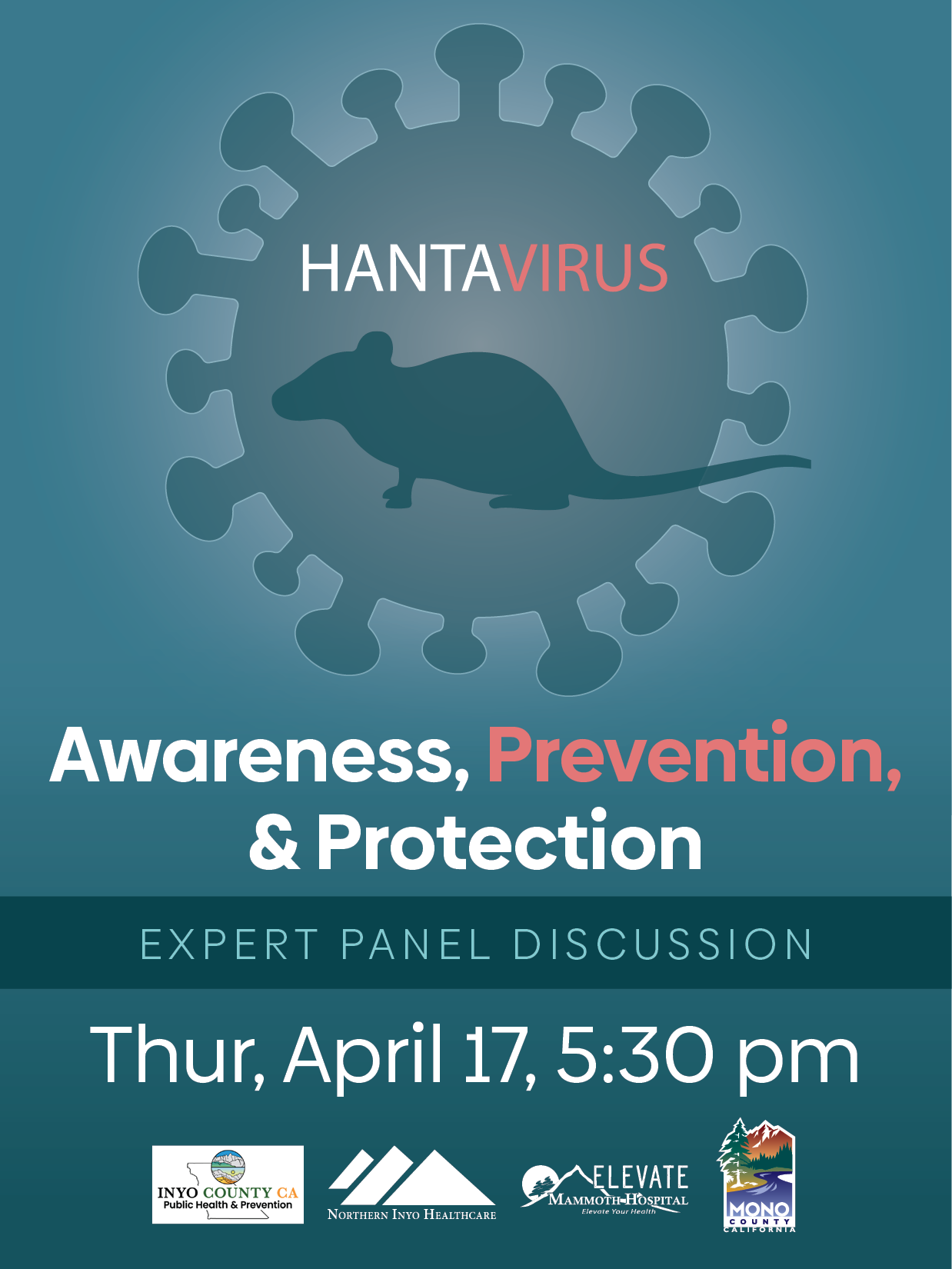
Following recent Hantavirus-related deaths in Mammoth Lakes, seven local health agencies are coming together to host an important public information event: Hantavirus: Awareness, Prevention & Protection
Date: Thursday, April 17
Time: 5:30 p.m.
Location: Online via Zoom and YouTube
How to Join:
- Zoom: Go to www.nih.org and click the blue banner at the top of the page or visit: https://us06web.zoom.us/j/86094592710
- YouTube: Visit YouTube.com/@NorthernInyoHealthcare
- If you miss the live event: A recording will be available on the NIHD YouTube channel.
Thanks to Mono County Public Health, live Spanish interpretation will be available. Just click the blue banner at NIH.org, join the talk, and wait for the screen prompt to select Spanish translation.
Presented by: California Department of Public Health, Mono and Inyo County Public and Environmental Health Departments, Mammoth Hospital, and hosted by Northern Inyo Healthcare District.
Meet the Panel of Experts:
- Dr. Anne Kjemtrup – Hantavirus Specialist, California Department of Public Health
- Dr. Tom Boo – Public Health Officer, Mono County
- Dr. James Richardson – Public Health Officer, Inyo County
- Louis Molina – Director, Mono County Environmental Health
- Jerry Oser – Director, Inyo County Environmental Health
- Dr. David Araya – Internal Medicine Hospitalist, Mammoth Hospital
- Dr. J. Adam Hawkins – Chief Medical Officer, NIHD (Host)
Submit advanced questions for the panelists to [email protected], subject line “Hantavirus Question”.
Why this matters: Hantavirus is a rare but serious disease carried by deer mice, which are common in the Eastern Sierra. People can get sick by breathing in virus particles stirred up from rodent droppings, urine, or saliva, especially when cleaning enclosed spaces. It does not spread from person to person.
This year, three local deaths from Hantavirus have already been confirmed ̶ an unusually high number for early spring. Officials emphasize that as far as is known at this time, none of the deceased individuals engaged in activities typically associated with Hantavirus exposure.
“This is tragic and concerning for our communities,” said Dr. Tom Boo, Mono County’s Public Health Officer. “We want to make sure everyone who lives, works, or visits the Eastern Sierra knows how to protect themselves and stay safe.”
Watch to learn:
- What Hantavirus is and how it spreads
- Early warning signs and symptoms
- How to clean safely and reduce your risk
- What to do if you or someone you know may have been exposed
Symptoms usually appear one to five weeks after exposure and include:
- Fever, headaches, and muscle aches
- Upset stomach, vomiting, or diarrhea
- Later: cough, trouble breathing, and fluid in the lungs
Hantavirus can be deadly ̶ about one in three cases results in death. Getting medical help early can save lives.
How to stay safe:
- Seal up holes larger than a pencil to keep mice out
- Store food in rodent-proof containers
- Trap mice using snap traps (not glue or live traps)
- Don’t vacuum or sweep mouse droppings, nests, or urine as this can release the virus into the air
- Air out enclosed spaces for at least 30 minutes before cleaning
- Spray contaminated areas with a disinfectant or a freshly made 10 percent bleach solution and let sit for five minutes before wiping clean
- Wear gloves and an N-95 (or higher) mask when cleaning
- Do not eat food that may have been contaminated by rodents
- Always wash your hands thoroughly after any possible exposure


Discover more from Eastern Sierra Now | Local News
Subscribe to get the latest posts sent to your email.