





Don Bowie’s Thirteen-Year Conversation with the World’s Most Dangerous Mountain

Don Bowie’s Thirteen-Year Conversation with the World’s Most Dangerous Mountain
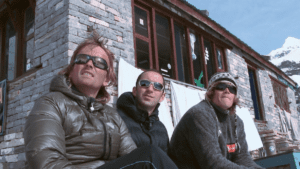
“There is no arguing with the mountains. They are indifferent to our notions of strength. While we wander among them, they either choose to let us pass, or close their arms and hold us forever.
“There’s not much we can do to change their mind.”
By the time alpinist and documentarian Don Bowie speaks these words in his new film, Annapurna: Dreams and Nightmares, the world’s most dangerous mountain has already rejected him twice. Annapurna’s statistics are sobering—it is one of the world’s fourteen peaks that surpass 8,000 meters, the tenth-highest on the planet at 26,545 feet. Avalanches are common, and the climb is steeper than most. The weather is unpredictable even among the “eight-thousanders.” Its fatality-to-summit rate was once as high as one-in-four. Of the 365 people who’ve attempted its summit, 72 have died on the mountain, including some of Bowie’s friends and colleagues.
Who in their right mind would even attempt this? It’s an age-old question, and words aren’t really equal to the task of explaining it. The cliché used to be “because it’s there.” In the film Bowie ponders the question but wisely doesn’t try to answer it: “What is it about human nature that makes us insatiable? The billionaire who keeps making money, the athlete who keeps coming back to compete.”
The film begins in Bowie’s childhood and origins with mountaineering (he narrates from the RV where he spent his earliest years in Bishop as a young climber), but centers upon his attempts at Annapurna, covering a span of thirteen years. Bowie was documenting his summit attempts on early digital camcorders even back in 2006, and thus the film is a temporal journey as much as it is geographical—you see the camera quality improve with time, you see Bowie age and grow as a climber. There is a subtle, but perceptible, change in his voice as he ages in the film.
This description perhaps sounds like a straightforward narrative of man-conquering-nature, but this film is not that. It is more a meditation on the meaning of failure and success in mountaineering. Bowie does not believe in the conventional “summit or bust” relationship with the mountains; sometimes he will say this outright but it’s more often an undercurrent, a governing theme.
Through its chronicling of Bowie’s attempts at Annapurna, the film secondarily functions as a passionate endorsement for that style of climbing, for that kind of relationship with the landscape. Bowie is collaborating with the mountain as much as he is with his fellow climbers, and, as it sometimes does with his fellow climbers, occasionally that collaboration goes sour. Like any friction in any relationship, it’s critical to know when to let it lie for the time being. His frustration at not summiting is palpable in the moment, especially in the older footage. But if you asked him if he could trade those experiences for a guaranteed first attempt summit, it appears the answer would be resoundingly in the negative. Bowie’s many failures on Annapurna are a critical component of his relationship to it—not something to be deleted on the way to a triumphant finale, but a constructive building block in support of that eventual triumph.
The film capably takes the viewer inside the subculture of high-altitude alpinists. Everything is higher-stakes in the death zone, even something as seemingly trivial as personality compatibility. Bowie does not give the specifics, but on the 2008 expedition he and the famed Spaniard Inaki Ochoa got into an argument on the mountain that essentially ended Bowie’s expedition. Bowie had the choice of either trying the summit alone, or going back, and he chose the latter. Ochoa and his Romanian partner Horia Colibasanu went on, whereupon Ochoa was incapacitated due to frostbite and an eventual seizure. Bowie and the climbers who did not summit mounted the most vigorous rescue they possibly could at that altitude. In a fictional movie, this is the moment where they’d heroically rescue Ochoa and the friends would reconcile. In reality, Ochoa didn’t make it. At the request of his family, he remains on Annapurna.
Some of the expedition footage is astonishing. It can be difficult from the comfort of sea level to get an accurate sense of the physical feats that are accomplished by climbers in these regions. There is a moment during the 2013 expedition when Annapurna is essentially raining rock down on Bowie and his friend and climbing partner Ueli Steck. This is a high-stakes moment; a stone the size of a golf ball comes down the mountain fast enough to kill a person. They were already attempting one of the more dangerous routes on the world’s most dangerous mountain, and now conditions were becoming lethally uncooperative. Bowie declines to try for the summit in the horrific conditions, but Steck simply presses on, one step at a time into the teeth of a rapidly clouding sky and probable avalanche. Before long, Steck is simply a dot in their vision. Draw the smallest dot you can with a permanent marker on a piece of computer paper, and that was Steck. Another climber on the expedition described the clouds forming behind Steck as “the curtain closing behind him,” and their Swiss companion was simply gone from their vision. Steck returned a full day later, having not slept at all, only climbed, with the understatement of the century: “Summit. We can go home now.”
Late in the film, during the 2019 expedition, Bowie and his companions are on a part of the mountain called the “Dutch Rib,” and the only comparison I can think of is those pictures of scaling mountain goats that appear photoshopped. On another attempt, Bowie crosses snow bridges that leave gaping holes into 100 feet of open darkness when he moves his boot. At one point, he sets up his tent on what he believes to be safe ground, only to be awoken by a sound like glass breaking, as the ice begins to fail underneath him.
Near the end there is a breath-catching roll call of the characters you’ve met throughout the film, demonstrating how ever-present are the risks in high-altitude alpinism, and just how thoroughly its practitioners embrace those risks.
I liked Don Bowie when I met him. He’s a passionate advocate for his sport, thoughtful and articulate in the way that only the most passionate can be. He holds opinions on the usage of supplemental oxygen that probably will ruffle feathers in certain corners of the sport. He defends those opinions well. The bottled oxygen question is thoroughly backgrounded in Annapurna, but that may well be what is taken from the film. That would be a shame in my view. This film is chiefly an expression of Don Bowie’s personal philosophy towards climbing. The oxygen question is one component of that, but far from the whole. As a window unto that comprehensive personal ethos, the film succeeds beautifully.

“Annapurna: Dreams and Nightmares” is available for rent and purchase online at www.annapurnafilm.com.
Discover more from Eastern Sierra Now | Local News
Subscribe to get the latest posts sent to your email.




Incredibly well written! Please give us more of Kevin McCormick. Really, really great writing.
I agree 200%